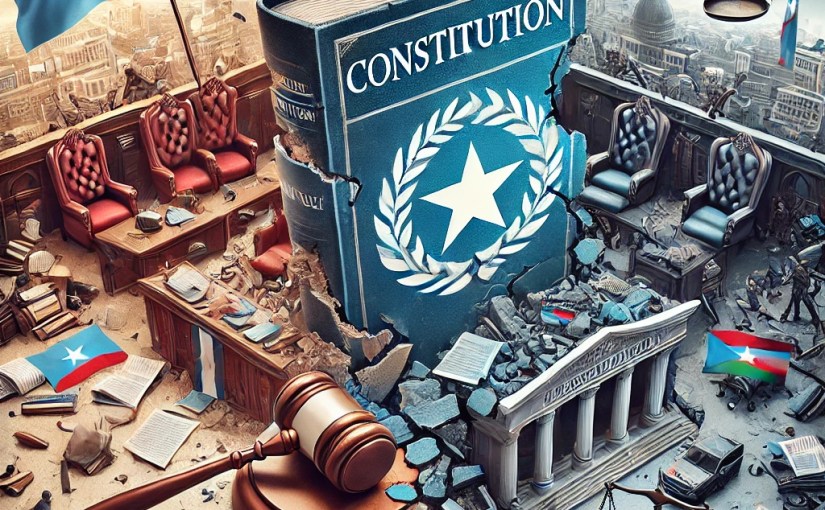
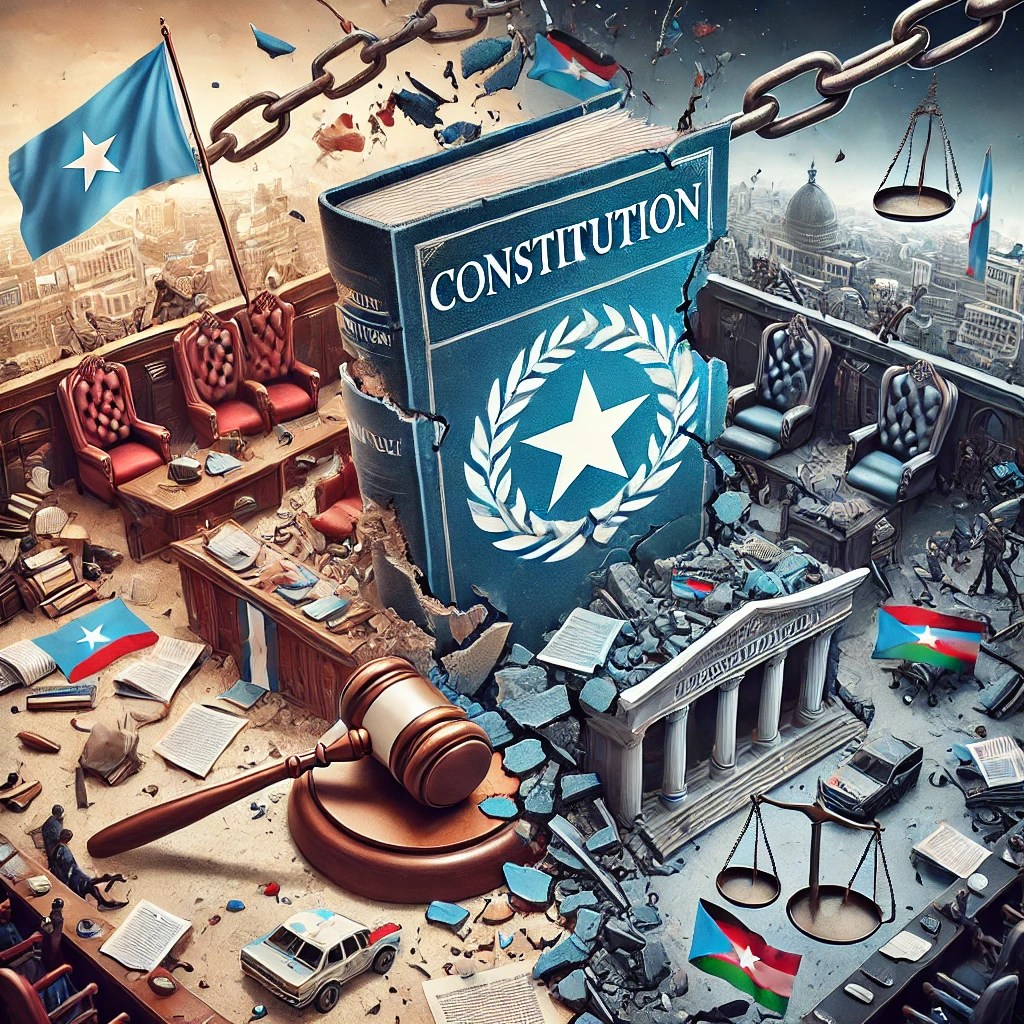
Somalia, a country marked by decades of conflict and political fractures, today finds itself in an institutional situation that borders on absurdity. Its provisional Constitution, adopted in 2012, was to be the basis of a modern and federal state. But the absence of a constitutional judge has transformed this ambition into a cynical farce, where respect for constitutional norms is relegated to the background in favor of power struggles between the executive, the legislature and regional entities. It’s a real Institutional Wild West, where laws are weapons of circumstance, brandished to establish selfish interests, rather than instruments serving the common good.
1. An orphan Constitution: the illusion of federalism
When Somalia adopted an interim Constitution, it embarked on the path of federalism, a structure supposed to ease tensions between the central power and the regions. However, in the absence of a credible and impartial mechanism to arbitrate constitutional disputes, this federalism has transformed into a fool’s game.
Federated states, such as Puntland, Jubaland and Somaliland (which claims its independence), regularly challenge the authority of the federal government. They consider themselves not as partners in a national project, but as autonomous entities ready to fight to preserve their prerogatives. Conflicts of jurisdiction are legion, and in the absence of a constitutional judge to decide, these disputes are resolved through opaque negotiations, threats, or worse, armed violence.
The federal government, for its part, oscillates between clumsy attempts at authoritarian centralization and capitulation to the demands of the regions. This instability is not only a political crisis: it is a major obstacle to the reconstruction of the country.
2. Parliament: a shadow theater
The Somali parliament, supposed to be the repository of popular will, has become a reflection of endemic corruption and a total lack of accountability. Deputies, often elected under opaque conditions, do not represent citizens but clans or private interests.
Without a robust constitutional framework, parliament engages in incessant quarrels with the executive. Motions of censure, votes of no confidence and suspensions of parliamentary sessions are not instruments of democratic control, but political weapons used to extort concessions or settle personal scores.
The absence of a constitutional judge exacerbates this anarchy. When conflicts arise between parliament and the executive, there is no institutional mechanism to determine who is right. The result is a chronic paralysis of the legislative process, which leaves the country without clear laws and coherent policy.
3. The executive: unbridled power
In this legal vacuum, the executive, led by the president and the prime minister, often acts without any control. Appointments, dismissals and political decisions are made in disregard of the procedures provided for by the Constitution.
The president, in many cases, behaves more like a clan leader than a head of state. Alliances are made and unmade not based on national interest, but on ethno-political calculations. This situation is all the more alarming as it fuels intercommunity tensions and aggravates the fragmentation of the country.
The prime minister, for his part, oscillates between loyalty to the president and desires for independence. This relationship, which should be framed by clear rules, is often marked by open crises, with disastrous consequences for the stability of the executive.
4. The Federated States: uncontrollable baronies
In this context, the federated states behave like autonomous fiefdoms, regularly defying the authority of the central government. State presidents often act like warlords, using their local security forces to establish their power and resist federal interference.
Disputes over the sharing of resources, particularly oil revenues, illustrate this anarchy. Without a constitutional court to arbitrate these conflicts, each side imposes its own interpretation of the law, often by force.
5. Citizens, major victims of this chaos
In this institutional war, Somali citizens are the first victims. They live in a State where fundamental rights, although guaranteed by the Constitution, are only empty words. The absence of a constitutional judge means they have no recourse against abuses of power, arbitrary detentions or human rights violations.
Public services, already limited, are paralyzed by political instability. Essential sectors such as health, education or security are abandoned, leaving the population to fend for themselves.
6. The price of the constitutional void
The absence of a constitutional judge in Somalia is not a simple institutional deficiency. It is a crime against democracy and the rule of law. This situation allows individuals and groups to hijack institutions for their own benefit, transforming the Somali state into a battleground for vested interests.
Federalism, instead of being a tool for unity in diversity, has become a pretext for fragmentation. Institutions, supposed to serve the people, are only window dressings to mask the brutal reality of power exercised without control or accountability.
7. Solutions et perspectives
To get out of this impasse, several measures are i
- Establish a Constitutional Court: An independent institution, composed of competent and honest jurists, must be set up to guarantee respect for the Constitution and arbitrate conflicts.
- Strengthening the rule of law: Deep reforms are needed to fight
- Revise the Provisional Constitution: The current text, marked by ambiguities and
- Engage in a national dialogue: All parties, including states and civil society, must engage in dialogue to redefine the Somali national project.
Conclusion
Somalia cannot afford to continue navigating the murky waters of institutional anarchy. The absence of a constitutional judge is a deadly flaw in its political system, which threatens to transform the country into a patchwork of rival fiefdoms. The Constitution, which should be a shield against arbitrariness, has become a weapon in the hands of the powerful.
If nothing is done to address this situation, Somalia will continue to descend into chaos, with tragic consequences for its people and the region as a whole. This article is an urgent call to action: It is time for Somalia to equip itself with the institutional tools necessary to become a true rule of law.

 EX_DJIBOUTI SEMPER ALIQUID NOVI
Vous devez être connecté pour poster un commentaire.