

“Juris praecepta sunt haec : honeste vivere, alterum non laedere, suum cuique tribuere.”
(The fundamental principles of law are as follows: live honestly, do no harm to others, give everyone what is due to them.)
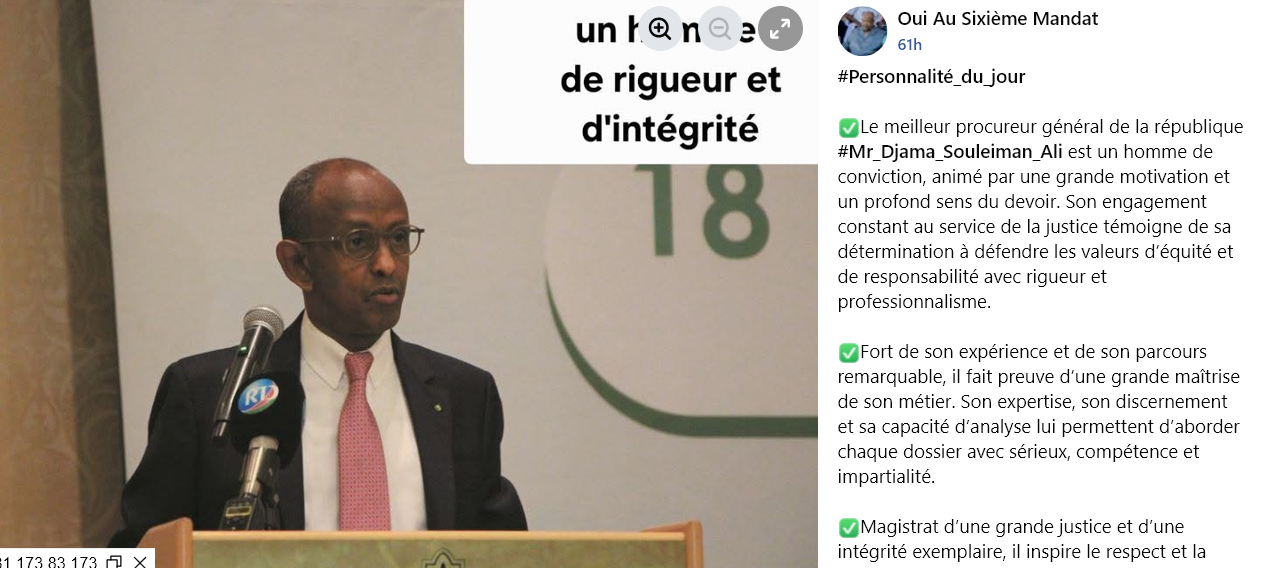
There are texts that smell of ink. There are others that smell of fear. And then there is this post entitled “Personality of the Day”, which reeks of hot wax, worn-out red carpet, industrial flattery, and the moral floorcloth hastily dragged across the entrance of a dignitary’s office in order to make the ground appear clean.
Upon reading this prose, one hardly knows whether to laugh, retch, applaud ironically, or summon a court clerk to record the offence. For this is not merely a small tribute. It is not simply an ill-inspired piece of courtly promotional writing. It is a symbolic crime scene. The victim? JUSTICE. The involuntary accomplice? THE REPUBLIC. The humiliated parties? The citizens of Djibouti, in whose name justice is supposed to be rendered, not confiscated, disguised, perfumed, stuffed, and then displayed like a trophy in the drawing room of the powerful.
We are therefore informed, with drums beating and flattery at the ready, that Mr. Djama Souleiman Ali is allegedly “the best Prosecutor General of the Republic.” An admirable degree of precision. The best, no less. Not simply a magistrate. Not merely a senior official. No: the best. With this kind of vocabulary, we are no longer in the realm of judicial administration; we have entered an agricultural fair. Category: sacred bovine of the prosecution service. Special jury prize: longevity in a sensitive office. Special mention: exceptional ability to survive files, controversies, international humiliations and, above all, changes of scenery.
The most comic element — or the most tragic, depending on the condition of one’s democratic stomach — is that the Council of Ministers of 15 October 2024 officially stated that Mr. Djama Souleiman Ali had been appointed President of the Supreme Court, while another magistrate was appointed acting Prosecutor General at the Supreme Court. Even the promotional post, it seems, can no longer keep track of the labels of power: prosecutor yesterday, president today, administrative saint forever. When praise becomes automatic, it no longer verifies the office; it venerates the name, the armchair, the shadow cast by the system. (presidence.dj)
This post does not pay tribute to Justice. It places a velvet muzzle upon it.
It dares to speak of equity, as though equity were a decorative object hanging on the wall of an air-conditioned office. It dares to speak of responsibility, as though responsibility consisted in remaining so long within the machinery of the judicial apparatus that one eventually no longer knows whether one serves the institution or whether the institution serves as one’s second residence. It dares to speak of impartiality — that sublime, fragile word, a word that ought to be pronounced standing upright, with clean hands and a clear gaze. Here, however, it is thrown into a Facebook post as one sprays perfume over a dustbin left under the sun.
And what is one to say of “exemplary integrity”? The expression is magnificent. It possesses the rounded softness of polite falsehoods. It resembles those excessively sweet pastries served to guests in order to make them forget that the kitchen is infested. Exemplary integrity? Very well. Then let us set the example. Let us open the files. Let us open the archives. Let us open the careers. Let us open the appointments. Let us open the durations of office. Let us open the decisions. Let us open the silences. Let us open that great institutional cupboard where, for decades, embarrassments, discomforts, acts of obedience and judicial miracles arriving always at the right moment have been stored away.
For the real scandal is not that a man is praised. After all, in a healthy Republic, a magistrate may be respected. The real scandal is that the people of Djibouti are being asked to swallow this praise like a civic host, when Justice itself has so often been ordered to lie down, remain silent, serve, obey, strike accurately when power identifies a target, and look elsewhere when the target wears an official suit.
We are told he is a “man of conviction.” Yes, perhaps. But what conviction are we speaking of? The conviction that the prosecution service can become a border post between law and expediency? The conviction that a sensitive case is never truly legal when it can be made political? The conviction that the Republic is a house into which some enter through the grand door while the ordinary citizen waits outside, barefoot, case file in hand, honour trampled underfoot, rights adjourned?
We are told of his “deep sense of duty.” But the duty of a magistrate is not to endure indefinitely. It is not to please. It is not to serve as the lock on every strongbox of power. It is not to become the factotum of sensitive crises, the useful shadow behind political settlements, the penal notary of anger from above. The duty of a magistrate, especially within the prosecution service, is to be the mouth of the law — not the loudspeaker of a regime, not the concierge of the powerful, not the maître d’hôtel of “arranged” files.
The prosecution service is not a private salon. Justice is not a family enterprise. The Republic is not a buffet at which a few come to help themselves while the people wash the plates.
This post is humiliating because it treats Djiboutians as distracted children. It assumes that it is enough to write three gilded adjectives — rigour, professionalism, impartiality — for citizens to forget the cases, the scars, the contradictions, the public humiliations. It assumes that national memory is a magic slate: shake it a little, and everything disappears. The problem is that the people are not amnesiac. They are merely constrained into silence. And silence is not forgetfulness. It is sometimes the most concentrated form of accumulated contempt.
Let us consider the Borrel affair. Here, we leave the theatre of praise and enter the fog of statecraft. In 2007, Le Journal du Dimanche recalled that Mr. Djama Souleiman Ali had claimed to have uncovered a paedophile network involving French expatriates, a line of inquiry that he linked to the death of Judge Bernard Borrel. The same article noted that this revelation came at a time when he himself was being prosecuted by the French authorities for witness tampering in connection with that case. Thus we are presented with “discernment” in its grand laundering version: when the case burns, one releases a different smoke — thicker, more spectacular, more nauseating — so that no one knows where to look anymore. (lejdd.fr)
Europe 1 also reported at the time that Djama Souleiman Ali and Hassan Saïd Khaireh had been committed for trial before a criminal court by the French judiciary and were subject to international arrest warrants in the witness-tampering strand of the Borrel affair. (europe1.fr) A procedural document before the International Court of Justice likewise mentions the complaint filed by Élisabeth Borrel for witness tampering, the judicial investigation into possible pressure exerted on two Djiboutian nationals heard as witnesses, and arrest warrants issued by the Versailles investigating chamber in 2006. (icj-web.leman.un-icc.cloud)
And this is the man now presented to us as an icon of impartiality? Come now — a little decency! Even propaganda should sometimes reread itself in front of a mirror. One may love power, one may carry its train, one may even gratefully collect the crumbs from its table; but there is a limit to ridicule. Here, we have entered the institutional circus. The clowns wear black robes, the acrobats juggle warrants, and the audience is the Djiboutian citizen, asked to pay for the ticket, laugh at the proper moment, and above all refrain from asking questions.
Then came the Boreh affair, that other great judicial fresco in which the Republic of Djibouti was dragged into an international arena and the local varnish began to crack under the cold light of a foreign court. In the London proceedings, the judge of the High Court referred to the “improper conduct” of the Republic and expressly cited Mr. Djama Ali, then Attorney General, in the context of Mr. Boreh’s conviction for terrorism, which rested on misdated telephone transcripts and attempts to justify it through false evidence. The judgment also noted the continued use of these materials in extradition efforts and in connection with an Interpol notice. (lexlaw.co.uk)
Read that carefully. This is not an agitated opponent speaking in a back room. It is not a pamphleteer losing his temper in the central market. It is an English judge, in a public judgment, describing conduct that cannot be repainted with three layers of “professionalism” on Facebook. At this level, praise is no longer mere flattery: it is intellectual sabotage. It is an invitation to citizens to blindfold themselves while the meaning of words is stolen from them.
The same judgment referred to an “unsafe” conviction, an unreliable confession, and conduct by the Republic that fell far below the standards expected of a sovereign state. (lexlaw.co.uk) Once again, where are the much-vaunted values of equity? Where is exemplarity? Where is the honour of the Republic? When a state is described in such terms abroad, it is not merely a case that collapses: it is the face of the country being dragged through the mud. And who pays the price of the humiliation? Not the architects of the fabrications. Not the courtiers who applaud. Not the manufacturers of perfumed posts. It is the citizens of Djibouti. Always them. The invisible taxpayers. The permanent humiliated. The true owners of a Republic that others use as a company car.
In the same case, the judge considered that the conviction for terrorism and the subsequent conduct formed part of a campaign against Mr. Boreh and his business interests. He wrote that the relevant authorities were clearly complicit not only in the manufacture of false evidence but also in concealing the false and unsafe nature of that conviction. (lexlaw.co.uk) And meanwhile, back home, one reads: “A magistrate of great justice and exemplary integrity.” One needs a strong diaphragm not to burst out laughing. Or tears already dried up not to weep.
For this is the supreme humiliation: not only is Justice abused, it is then forced to smile for the photograph. A clean robe is placed over dirty wounds. It is made up. It is told: “Stand straight, Themis, the communiqué is coming.” Its eyes are covered, no longer to guarantee impartiality, but so that it does not see who pulls the strings. A set of scales is placed in its hand, but the interests have already been weighed elsewhere. It is given a sword, but only to strike those designated to it.
And when a citizen dares to ask, “In whose name is this justice being rendered?”, the answer comes: in the name of the Djiboutian people. What a cruel farce. What a sinister joke. In the name of the people? Did the people ask for justice to be transformed into a workshop of fabrication? Did the people ask for procedure to become a trap for opponents or economic adversaries? Did the people ask for the image of the Republic to be damaged in foreign judgments? Did the people ask to be humiliated, and then served the next day with a publication praising exemplary integrity?
No. The people asked for nothing of the kind. Others speak in their name, act on their backs, lose in their honour, pay with their money, and then invite them to applaud.
The High Court ultimately concluded that all claims brought by the claimants against Mr. Boreh and his companies failed. (lexlaw.co.uk) According to a summary published by 7KBW, the court also ordered the Republic of Djibouti to pay £9.3 million as an interim payment on the defendants’ costs, with costs awarded on an indemnity basis. (7kbw.co.uk) That is the real record omitted by the post. The courtiers count the adjectives; the citizens count the millions. The former distribute cardboard medals; the latter inherit the bills.
So when the promotional text asserts that this man “inspires the respect and confidence of all,” the question becomes: of which “all” are we speaking? All the beneficiaries of the system? All the regulars in the air-conditioned corridors? All those who have understood that, in Djibouti, respect is sometimes measured by the distance one keeps from the powerful? Because the ordinary citizen does not necessarily have confidence. He observes. He endures. He knows that certain names open doors while others close them. He knows that justice can run very fast against the weak and stroll in slippers when facing the strong. He knows that the law, in certain cases, is not a principle: it is a variable-geometry weapon.
This post is a slap in the face of honest magistrates. For they do exist. There are magistrates who work without spotlights, without fanfare, without promotional posts, without improvised fan clubs. There are magistrates who still believe that the robe is not a costume, that the law is not a commodity, that the prosecution service is not a liaison office between the public interest and the moods of the summit. To those magistrates, this post says: “Your silent integrity does not matter; the institution celebrates those who know how to remain near the fire.”
This post is also a slap in the face of court clerks, lawyers, litigants, families awaiting decisions, victims seeking truth, innocent people who fear fabrications, and poor people who discover that justice is more expensive when one has no protector. They are told: “Look, here is our model.” And what a model it is: the model of opaque longevity; the model of the locked armchair; the model of a career that resembles less a public service than a port concession renewed without tender.
It must be said forcefully: a Republic in which sensitive offices become de facto properties is no longer a fully healthy Republic. It is a feudalised administration. One may enter it through competitive examination, perhaps; one survives there through networks, certainly; one reigns there through political usefulness, manifestly. And then, when the wear becomes too visible, when affairs leave traces, when citizens murmur, the drums of communication are brought out: “Personality of the Day.” As though a slogan could erase twenty years of questions. As though a publication could transform lead into gold. As though Justice were an old wall repainted before the owner’s visit.
But Justice is not a wall. It is the central pillar of the Republic. When it is humiliated, everything collapses silently. When it is instrumentalised, the citizen loses confidence. When it is confiscated, the state becomes suspect. When it is disguised, the Republic becomes theatre. When it is prostituted to the interests of the moment, the people understand that the law is no longer a protection, but a stage set.
And the most insulting aspect of this affair is the obscene use of noble words. Equity. Responsibility. Rigour. Honesty. Law. These words are not confetti. They are not spices sprinkled over a spoiled dish. They are demands. Equity must be demonstrated. Responsibility must be assumed. Rigour must be verified. Honesty must be subject to scrutiny. The law must apply to all, or else it ceases to be law and becomes a leash.
One does not become a model because a post decrees it. One does not become honest because a Facebook page perfumes one’s image. One does not become impartial because a courtier has found the adjective in a dictionary. Integrity is not aftershave for tired senior officials. It is a discipline. It is a form of solitude. It is the ability to say no, even when the phone call comes from above. It is the ability to allow a file to breathe without fitting it with a political muzzle. It is the ability not to confuse the Republic with the interests of those who occupy it.
That is why this post must be denounced with ferocity. Not because it celebrates a man, but because it humiliates an institution. Not because it is clumsy, but because it is revealing. It reveals a political culture in which praise replaces assessment, proximity replaces merit, communication replaces accountability, and embarrassing files are buried beneath administrative wreaths.
This is not a “Personality of the Day.” This is a personality of the system. Of the system that adores indispensable men because they make institutions dependent. Of the system that prefers interminable careers to impersonal rules. Of the system that transforms magistrates into cogs, cogs into guardians, guardians into proprietors, and citizens into spectators politely asked to stand when the procession passes.
So yes, one must respond. One must respond that Djiboutian Justice is not a doormat on which the powerful wipe their shoes before entering the salon of respectability. One must respond that the Republic is not a suit worn abroad and crumpled at home. One must respond that Djiboutian citizens are not extras in the promotional film of those who have privatised public dignity.
One must respond that we no longer want saints manufactured by promotional mailing. We no longer want “best prosecutors” self-proclaimed by a digital choir. We no longer want biographies covered in icing sugar to conceal careers that deserve examination, contradiction, transparency and public debate. We no longer want a Justice that kneels before names and rises only before the anonymous.
True Justice does not need fanfare. It needs independence.
A true Republic does not need courtiers. It needs counter-powers.
A true magistrate does not need to be “Personality of the Day.” He must accept being answerable before the law, accountable for his acts, and replaceable in his office.
All the rest is decoration upon a national humiliation. A layer of golden paint over a deep fissure. A cruel joke at the expense of the people. A court farce, written by trembling hands, to celebrate not Justice, but its captivity.
And let the authors of this promotional post keep their incense: it no longer masks the odour of institutional staleness. Djiboutian Justice does not need perfume. It needs air.

 EX_DJIBOUTI SEMPER ALIQUID NOVI