
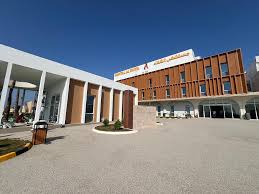
There would be scandals that break into history. There would be others who would advance in an official procession, ribbon cut, microphones opened, speeches starched, smiling photographs and vocabulary perfumed with modernity. The case of Al Shifa Hospital , if the figures advanced and the suspicions that would circulate were confirmed, would belong to this second category: not the clandestine scandal, shameful, trembling in a dark corridor, but the scandal in ceremonial dress, the one who would appear before the people with the satisfied expression of the benefactor and the hand already placed on the pocket of those whom he claimed to serve.
Because that is where we should start: what is shocking is not the idea of building a modern hospital. No reasonable mind would be upset to see Djibouti get a quality establishment, able to limit the ruinous medical evacuations, to offer specialized care, to train doctors, to retain on the national territory a part of this Djiboutian pain which, too often, must go into exile to hope to heal. Non. What would be revolting, if the information mentioned were accurate, is the abyssal gap between the noble health promise and the supposed opacity of its financial structure. It would be this unpleasant, insistent, almost nauseous impression that the health of the people would have served as a great white curtain behind which infinitely less hygienic operations would have been played off.
We would be told about progress. We would be told about international standards. We would be told about medical excellence, technical facilities, health sovereignty, modernity, and regional influence. Very well. The words are beautiful. They shine. They can feel the press release read three times by an image advisor. But words, by dint of shining, can also blind. And while the citizen was asked to admire the facade, he would be entitled to look at the foundations. While being shown the walls, the operating rooms, and the equipment, he would be entitled to ask the question that every taxpayer, every contributor, every worker, every potential retiree should ask: how much would it really have cost, who would have paid, who would have decided, who would have controlled, who would have benefited, and for whose benefit this hospital would operate tomorrow?
The rumor, or rather the estimate that circulates in certain informed circles, mentions an invoice exceeding 18 billion Djiboutian francs. Eighteen billion. Written in this way, the figure may still seem abstract, almost administrative, like those budgetary masses that are recited in the Council of Ministers without hearing about the human lives they contain. But eighteen billion Djiboutian francs, in a country where so many families calculate every expense, where the disease can become a financial condemnation, where the slightest medical examination can be experienced as a test, is not an accounting line. It’s a mountain. It’s a generation of contributions. It’s a portion of national sweat. It is the money taken from salaries, low incomes, silent efforts, scant payslips and strained end-of-month payments.
However, if we were to accept the hypothesis that the real cost of the structure could have been much lower than the amount mentioned, perhaps around one third of the alleged invoice, then the question would no longer be merely technical: it would become political, moral, social, almost civilizational. It would no longer be a question of knowing whether tiles had been paid too much or whether equipment had been poorly negotiated. It would be a question of understanding whether the money of the people would have been treated with the rigor due to a sacred resource or with the careless carelessness that is sometimes reserved for goods that do not belong to anyone because they belong to everyone.
Because the money of the CNSS is not a suitcase found by chance in the chest of a distracted administration. This is not the personal treasure of a board of directors, much less the private fund of a handful of inspired managers. It’s the social money. It’s the workers’ money. It is the money for old age, illness, accidents, medical coverage, and national solidarity. Every franc has a human origin: an hour of work, a contribution withheld, an employer’s contribution, a promise made to an employee that tomorrow, in case of a hard blow, the community would not abandon him by the roadside.
Therefore, presenting as « private » an establishment that would have been financed, directly or mainly, by the money of a social fund would pose a formidable problem. Not a small vocabulary problem, not a miscommunication mistake, but a kind of intellectual contortion worthy of the greatest bureaucratic sleight of hand. The word « private » would have something comical here, if the issue were not so serious. Private? Really? Private with whose money? Private with which venture capital? Private with what personal guarantees? Private, with what assets committed? Private with what risk-taking by shareholders? Private, like a car bought with the neighbor’s salary and whose keys we would then keep, explaining to the neighbor that he can admire it from afar?
In the real economy, the private sector normally means that investors commit their own funds, borrow under their responsibility, bear the risk of failure and, in return, can expect profit. But when the money comes from a social security institution, when the initial resource is collected from workers, when the sacrifice is collective, then the vocabulary should be monitored with surgical precision. Calling this « private » could be a semantic scam, a lexical hold-up, a communication pirouette intended to make the people swallow an operation for which they would be the funder without necessarily becoming its priority beneficiary.
And this is where the supposed scandal would reach its point of moral fusion. Because the real question is not just: who paid? The real question is: who will be treated?
Will CNSS members, those whose salaries would have fed the fund, have effective, simple, guaranteed, priority, affordable access to the establishment they would have helped to finance? Or will they have to, after paying through their contributions, pay again at the counter, take out their bank card, negotiate coverage, face a « remaining charge », a price list, a discreet exclusion, a social queue where the poor would be asked to applaud the showcases of modernity without actually crossing its doors?
The hypothesis would be unbearable: a hospital built with social money, but calibrated for a solvent clientele. An establishment born from the sacrifice of the modest, but offered to the comfort of the wealthy. An infrastructure financed by workers, but oriented towards those who can supplement, pay, advance, guarantee, consume. We would then have invented a Djiboutian marvel: the socialism of expenditures and revenue capitalism; the collectivization of financing and the privatization of access; solidarity upstream and selection by money downstream.
One should admire, despite oneself, the predatory elegance of the mechanism. The people would pay. A structure would be built. The structure would be declared modern. Modernity would justify high prices. High tariffs would drive away part of the people. And it would then be explained, with the compact gravity of technocrats who confuse cruelty and seriousness, that quality has a price. Yes, quality has a price. But when this price has already been paid by the contributors, it would be indecent to present them with a second addition.
Health should not become a luxury store set on the ruins of solidarity. A hospital financed by social money should not function as a prestigious clinic whose poor would be the involuntary shareholders and the predictable excluded. Because there would be something almost obscene to ask the workers to finance a medical cathedral so that they then only have access to the forecourt. It would be like building a school with the people’s taxes and then reserving the classrooms for children from families able to pay an extra fee. It would be like building a public road and then installing a toll that only the powerful can cross. It would be like asking the citizen to dig the well, then to sell him water at a high price.
And what about this communication which, instead of answering first the substantive questions, would multiply the operations of proximity in the chosen places with a sense of symbol which would confine to the ridiculous? A presence at the Bawadi Mall, between commercial windows and consumer traffic, would have something revealing. It seems that public health, in this enchanted vision of hospital marketing, is no longer addressed to the insured, to patients, to citizens, to contributors, but to customers. We no longer go to working-class neighborhoods to explain their rights to workers; we set up shop in a shopping center to attract customers. We no longer speak to Balbala, to modest families, to the forgotten peripheries, to patients who hesitate before consulting due to lack of means; People talk in the air-conditioned temple of consumption, where they sell phones, perfumes, coffees and perhaps now, premium health promises.
The « proximity approach » would then become an extraordinary formula. Proximity to whom? With ordinary contributors? With the retirees? With the workers? With women who wait for hours in saturated public structures? With families who dread the slightest prescription? Or proximity with purchasing power, with the solvent consumer, with the class that already has the possibility to choose, to compare, to pay? We would call this proximity, but it could look like a polite social selection. Proximity not geographical, but banking.
Perhaps the most worrying aspect of this matter is silence. The silence of institutions, if it were to persist, would be more deafening than inaugural speeches. Because in the face of an operation of this magnitude, it should not be necessary to wait for murmurs from the street, private complaints or citizen pamphlets. Oversight bodies should stand up on their own. The national representation should request contracts, amendments, calls for tenders, audits, evaluations, contracts, financing plans, guarantees, agreements linking the hospital to the CNSS, the exact structure of the capital, the pricing policy, the arrangements for providing coverage to policyholders, exemptions, benefits, and public service commitments.
What would a normal state require? Nothing extraordinary. Only the parts. The initial cost, the final cost, the beneficiary companies, the procedures followed, the award conditions, the control reports, the decisions of the board of directors, the administrative visas, the technical justifications, the details of the equipment, comparison with similar hospitals in the region, financial sustainability for the CNSS, impact on future benefits, protection of social reserves. It would not be persecution. That would be the elementary breathing of financial democracy.
But in some administrations, asking a question would already be treated as a declaration of war. Asking for an audit would look like an offense. Demanding transparency would become insolence.
The citizen would be asked to applaud, not to understand. To thank, not to check. To contemplate, not to count. And this is precisely where the institutional decadence begins: when those who manage public or social money end up considering that being accountable would be a favor, whereas it is the first of their obligations.
If the 18 billion put forward were accurate, this amount would have to be explained. If it was inaccurate, the actual figure should be published. If the suspected overbilling were an illusion, evidence would have to be produced to dispel it. If the critical estimates were wrong, they would have to be refuted with verifiable data, not slogans. If everything was regular, then nothing should be simpler than to establish it. Transparency is never dangerous for clean files. It only becomes threatening for cases that fear the light.
It would therefore not be a question of condemning without trial. It would be a matter of refusing organized sleep. It would not be a question of throwing names into the cloth. It would be a matter of requiring documents. It would not be a question of accusing for the sake of accusing. It would be a matter of reminding that social money is not a soft material, available for all experiments of prestige, all communication architectures, all legal-financial adventures whose clauses written in fine print the people discover too late.
The construction of a modern hospital could be a major national news story. She could be a source of pride. It could even be a major step towards better health sovereignty. But for that, the operation would have to be irreproachable. The origin of funds, their use, control and purpose should be perfectly clear. The contributors should know what they have financed, under what conditions, and with what concrete benefits for them. The hospital should not only be « modern » in its machines, but also in its governance . Because a state-of-the-art scanner will never compensate for opaque accounting. A brilliant operating room will never wash away a murky procedure. A new facade will never clear any suspicion of capture.
The case would also raise a broader question: what are we doing about national solidarity in Djibouti? Is it a moral pact between generations, or a financial reserve that could be mobilized according to the needs of the moment? Is it intended to protect policyholders, or to create institutional storefronts? Is it a shield for the weak, or a lever for montages that the people would only understand after the fact? The CNSS should be a sanctuary. Now a sanctuary ceases to be one as soon as its doors seem to be able to open up to the appetites best introduced.
Consideration should also be given to the exemptions and benefits granted to a hospital company that is presented as carrying out a high-quality project. Again, debate is not prohibited. A State may grant tax incentives when a project is in the public interest. But then this general interest must be demonstrated, measured, contractualized, opposable. If the state renounces tax revenues, if the CNSS mobilizes social funds, if administrative facilities are granted, then the social counterpart must be massive, clear and guaranteed. How many free or heavily subsidized consultations? How many beds are reserved for modest insured persons? Which tariffs are enforceable? What automatic support is there? What public service obligation? Which annual publication for social results? What independent control?
Without this, the risk would be to see a deeply unequal mechanism: the State would help, the CNSS would finance, the citizen would contribute, but real access would be sorted by the ability to pay. It would then be a double punishment for the people: to pay as a contributor, then to pay as a patient. And for the most modest, to pay for the first time without ever being able to fully benefit from what they have paid.
Perhaps we will be told, with the usual condescension of well-fed communicators, that we must be positive, that initiatives should be encouraged, that investment should not be discouraged, and that the image of the country should not be tarnished. The argument is known. It serves wherever transparency disturbs. But a country’s image is not tarnished when citizens demand accountability. She gets dirty when accounts are not accounted for. Investment is not discouraged by the audit; he discredits himself by the opacity. Modernity is not weakened by criticism; it is strengthened by the evidence. These are not the questions that damage the Republic. These are the missing answers.
We may also be told that the hospital will treat Djiboutians, that it will avoid evacuations, that it will provide skills. That’s good, if it checks out. But that doesn’t answer the original question. A good proclaimed purpose is not enough to make any montage acceptable. You don’t clear a procedure by brandishing an ambulance. One does not sanctify an invoice by mentioning a sick person. Health, precisely because it touches life, demands greater probity. It should never become the ideal screen for questionable arrangements, because nothing is easier than to silence criticism by accusing it of being hostile to care. Let’s be clear: it’s not the hospital we’re criticizing. That’s what could be hiding behind the hospital. It is not medicine that we are questioning. This is the governance of the money supposed to finance it.
If this case were to be exemplary, let it be so until the end. That the detailed cost be published. That the contracts be made public. That the exact role of the CNSS is explained. Whether the institution legally and economically belongs to the contributors, a company, the state, or a combination whose implications citizens are unaware of.
That the pricing policy is clarified. That the rights of insured persons are indicated. That it be shown that the social contributions have not been exposed to excessive risks. That it be proved that any tax and customs benefits have a social counterpart. That we finally establish whether the Djiboutian workers are the true beneficiaries of the project or only its silent funders.
The formula is cruel, but it would sum up the anxiety: Al Shifa could become, if we are not careful, the hospital where the people would have paid for the construction of their own exclusion. He would have supplied the bricks, financed the concrete, fueled the crates, borne the risk, then he would discover that access to the promise depends on a solvency that many do not have. That would be the modernity seen from the sidewalk. The progress contemplated behind a window. Health sovereignty turned into a catch-all product for the wealthy classes.
We should therefore refuse the anesthesia. Refuse this little music according to which it would be inappropriate to ask questions when the building is beautiful. Refuse to blackmail national pride. Reject the confusion between patriotism and silence. Patriotism is not the art of applauding with your eyes closed. It is sometimes the duty to ask, obstinately, what has been done with common money. Loyalty to the country is not about covering up grey areas; it consists in illuminating them before they become abysses.
And if, extraordinarily, everything were perfectly regular, then transparency would be the best defense of those responsible. That they publish. Let them prove. Let them audit. Let them answer. Let them turn indignation into information. That they oppose the suspicions not of superficial indignation, but of documents. Because the document is the antidote to suspicion. Data is the enemy of rumor. Control is the remedy to mistrust.
But while waiting for this evidence, the question would remain simple, brutal, impossible to bury under the inauguration bouquets: who really owns the Al Shifa Hospital? To the contributors who would have financed his birth? To national solidarity, which would have made it possible? To a company with public benefits? To managers who would speak on behalf of the people without handing them the keys? Who owns its walls, its future income, its pricing choices, its real mission?
And above all: who will be able to take care of themselves there without financial humiliation?
Here is the question that bothers. This is the question that no brochure should be able to drown. This is the question we should repeat until we get something other than official smiles and elements of language.
Because when a project is paid for by the people, the people do not ask for charity. He is asking for his due. When a social fund finances an infrastructure, the contributors are not spectators. They are the moral creditors of the operation. When a hospital is born from solidarity money, it cannot behave like a medical palace reserving its best rooms to those who can pay the price of silence.
Al Shifah Hospital could be a chance. It must not become a symbol of confiscation. It could be a progress. It must not become a showcase of inequality. It could be a tool of health sovereignty. It must not become the polished monument of opaque governance.
So yes, let’s ask the questions. With strength. With precision. With legal caution, but without civic shyness. Let’s ask for the accounts. Let’s ask for the contracts. Let’s ask for the rates. Let’s request the audits. We ask for the concrete rights of CNSS policyholders. Let’s ask what was paid, by whom, for whom, and under what conditions.
Because in a Republic worthy of the name, the money of the people should never enter a building by the main door to come out, a few years later, in the form of privileges, exemptions, opaque profits or inaccessible care.
And if we had to summarize this case in a single formula, it would perhaps be this one:
When the people pay for the hospital, they should not have to ask permission to be treated there.

 EX_DJIBOUTI SEMPER ALIQUID NOVI